What you will learn
- Explain what a domain name is and who manages it.
- Choose a short, clear name that doesn't infringe anyone else's rights.
- Check whether it is free in 14 extensions and find alternatives.
- Register it properly, in your own name, and keep it.
Module 1
Understanding domain names in 5 minutes
A name and an extension
A domain name is your address on the Internet, for example jardinsclara.fr. It is used both for your website (www.jardinsclara.fr) and for your e-mail addresses (contact@jardinsclara.fr).
It has two parts:
- the name you choose, here “jardinsclara”: up to 63 characters, using letters, digits and hyphens;
- the extension, here “.fr”. There are hundreds of them: national (.fr, .de, .ch, .be), generic (.com, .org, .net), regional (.alsace, .bzh, .paris) or themed (.online, .pro).
The “www” is not part of it: it is just a prefix, which you can use or not. Behind the name, a worldwide system called DNS tells computers where to find your website and your mailbox.
Registry and registrar: who does what?
Each extension is run by a registry, which keeps the official list of registered names. Afnic runs .fr, Verisign runs .com and .net, EURid runs .eu and DENIC runs .de.
You don't deal with them directly. You go through a registrar: OVHcloud, Gandi, IONOS, Hostinger and many others. The registrar sells you the name, takes the payment and passes the registration on to the registry. It often offers website hosting and mailboxes as well.
Each registry sets its own rules. The .fr is open to people and organisations based in the European Union, Switzerland, Norway, Iceland or Liechtenstein. The .eu is for EU citizens and for people and organisations based in the European Union, Norway, Iceland or Liechtenstein. The .com is open to everyone.
For each name, the registry publishes the creation date, the expiry date and the registrar. You can look these up with whois or its successor, RDAP. Private individuals' contact details stay hidden.
You rent a name, you don't buy it
When you “buy” a domain name, you are actually renting it, for one to ten years. After that it has to be renewed, usually every year.
If you forget to renew it, the name expires: your e-mails stop arriving and your website disappears. After a short grace period, the name becomes free again and anyone can register it: sometimes a competitor, sometimes a reseller who watches for expired names to sell them at a high price or fill them with adverts.
As for prices, expect about €8 to €15 a year for a .fr or a .com. Beware of €1 first-year offers: always look at the renewal price. Regional extensions (.alsace, .bzh, .paris) often cost a few dozen euros a year. And a few highly sought-after names, known as “premium” names, sell for much more.
What makes a good name
- Short and easy to dictate: try it over the phone. If you have to spell it out, look for something simpler.
- No accents: a name like
boulangerie-élise.fris possible, but causes trouble in e-mail addresses and on some devices. Writeboulangerie-elise.frinstead. - One hyphen at most, and no digits: people hesitate between “3” and “three”, and hyphens get lost when a name is said out loud.
- Think of the e-mail address:
contact@boulangerie-martin.frmust stay readable and unambiguous. - Avoid doubled letters where two joined-up words meet: they lead to typos (“atelierrouge”).
For a local business in France, .fr builds trust. If both the .fr and the .com are free, take both: one will redirect to the other, and nobody can take advantage of the confusion.
Trademarks and names already taken
A free name is not necessarily an allowed one. If it uses a registered trademark, the name of a well-known company or that of a local authority, the rights holder can have it transferred or deleted, for example through Afnic's Syreli procedure for a .fr, and sometimes claim damages.
Before buying, check for free in the INPI database, which lists French trademarks and companies. Also make sure a nearby business isn't already using a similar name.
And if your name is already taken? Don't rely on the expiry date: almost all names are renewed. Try a variant instead (adding your town, a different word order, a hyphen) or another extension. To buy a name from its holder, go through the registrar shown, and beware of middlemen asking for large sums.
Key takeawayYou rent a domain name from a registrar, which records it with the registry for that extension. Keep it short, without accents or anyone else's trademark, and register it in your own name.
Words to know
- Domain name
- The address of a website and of the e-mail addresses that go with it, made of a name and an extension, for example jardinsclara.fr.
- Extension
- The end of the domain name, after the last dot: .fr, .com, .alsace… Also called a TLD (top-level domain).
- Registry
- The organisation that runs an extension and keeps the official list of its names: Afnic for .fr, Verisign for .com.
- Registrar
- An accredited company that sells and renews domain names on behalf of its customers.
- Registrant
- The person or organisation in whose name the domain is registered. Only the registrant can renew, transfer or give it up.
- RDAP and whois
- Public services that show whether a name is registered, since when and with which registrar.
- Transfer code
- A secret code (also called an auth code or EPP code) that lets you move to another registrar without losing the name.
Module 2
Checking a domain name step by step
Type the name of your project
- Open the Choose a domain name tool.
- In the Project name or desired domain name field, type the name the way you would say it, for example “Martin Bakery”, with spaces and accents.
- You can also type a full domain name, such as
jardinsclara.fr.
TipNo idea yet? Click one of the examples below the field to see how the tool works.
Add a town and start the check
- The Town or region (optional) field is used to suggest local variants, for example “Colmar”.
- Leave it empty if your activity isn't tied to a place.
- Click Check.
- The message “Asking the registries…” appears for a few seconds: the tool is querying the official registries directly.
Read the suggested name and its quality notes
- Under “Your domain name”, the tool shows your text turned into a valid name: accents, spaces and small words (the, of, and…) are removed.
- “Martin Bakery” thus becomes
martinbakery, and a line reminds you what was changed. - Notes then assess it, for example “Short (12 characters)” and “No hyphen”.
- A warning triangle appears if the name contains digits, several hyphens, or two identical letters where two words meet.
Spot the free extensions
Two groups of tiles appear: The most used extensions (.fr, .com, .eu, .alsace, .org, .net) and Other extensions (.de, .ch, .be, .online, .info, .pro, .paris, .bzh). Each tile shows:
- Free: nobody has registered it, you can take it;
- Taken: with the year it was registered, the expiry date, the registrar and a “Visit the site” link;
- Check again: the registry did not answer, try again in a moment.
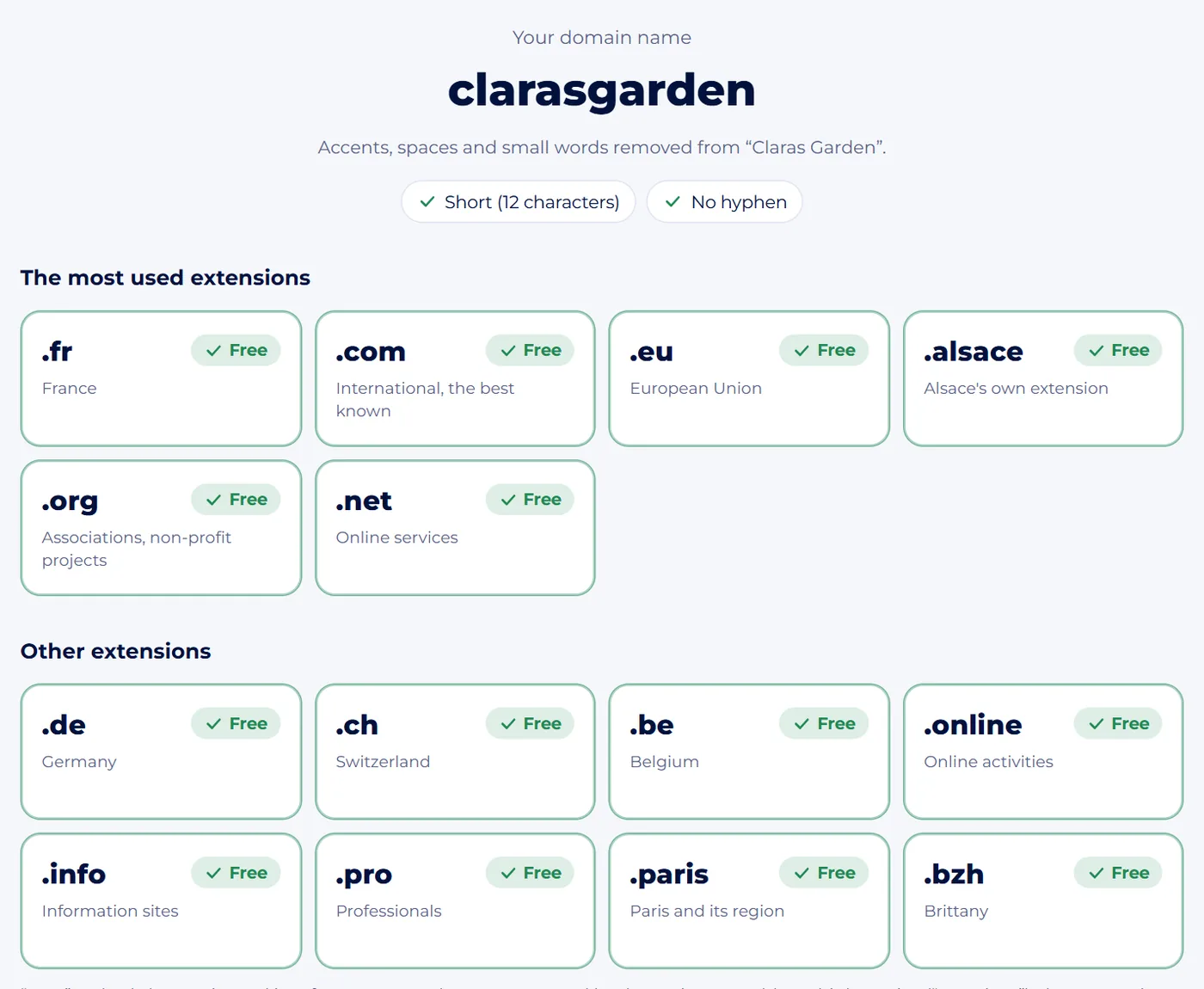
Screenshot : Choose a domain name Tip“Free” says nothing about the price: a few “premium” names cost more. The exact price is shown by the registrar.
Explore “More ideas”
- The More ideas table suggests up to eight variants: words joined up or separated by a hyphen, words swapped round, your town added…
- For each one, it shows whether the .fr and the .com are free.
- Click a variant to run a full check on all 14 extensions.
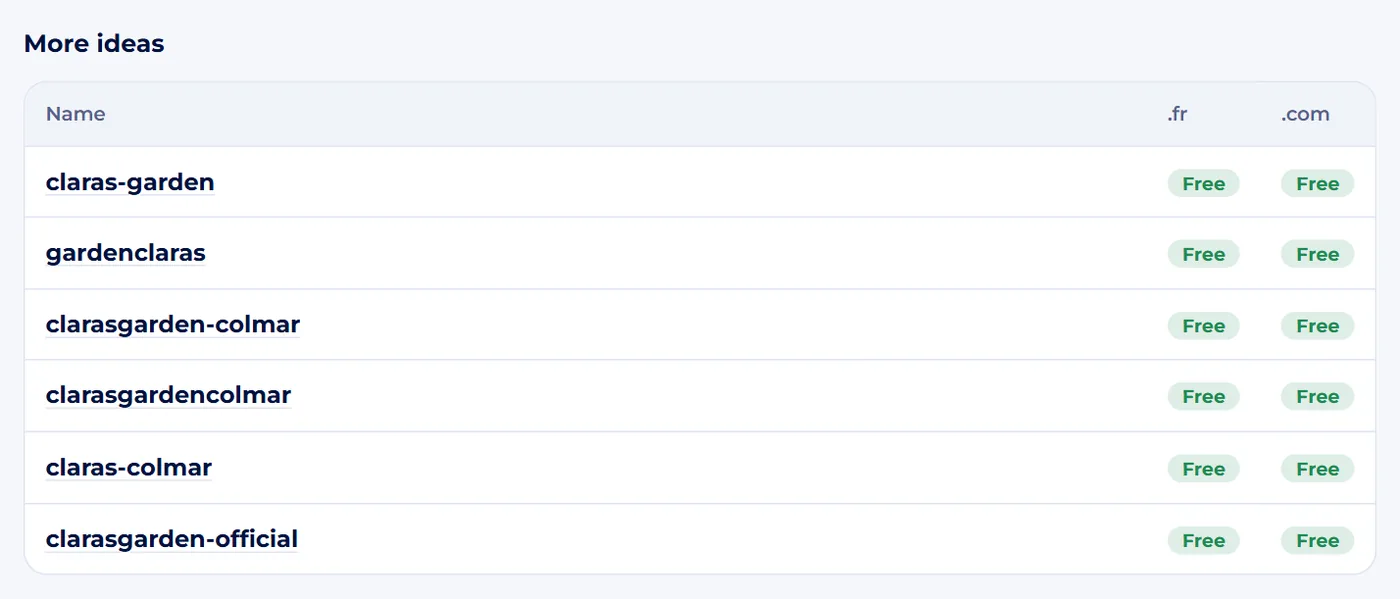
Screenshot : Choose a domain name Share your search, then register
- Before deciding, show the result to your business partner or your committee: the Copy the link to this search button copies an address that runs the same check again.
- Once you have made your choice, register the name without delay with the registrar of your choice.
- The tool sells nothing: your searches are never sold on, and nothing is kept for more than ten minutes.
TipBefore paying, check the name in the INPI trademark database.
All done: over to you.
Module 3
Practical cases
A bike repair association
The “Atelier Vélo Solidaire”, a community bike repair workshop in Mulhouse, wants a website and an e-mail address. The tool suggests atelier-velo-solidaire: three words, two hyphens, and the warning “2 hyphens: hard to dictate”.
With the town filled in, the association spots shorter forms in “More ideas”, such as atelier-solidaire or atelier-mulhouse. It picks a name that is free as both a .fr and a .org, takes both, and has the .org redirect to the .fr.
The ideal name is already taken
Claire is launching “Les Jardins de Clara”, a vegetable box scheme. The tool suggests jardinsclara. Suppose the .fr is taken: registered since 2015 with a registrar, and due to expire next year.
Rather than wait for an expiry that will probably never happen, Claire adds her town and picks a free variant such as jardinsclara-obernai.fr. She also checks with INPI that “Jardins de Clara” is not a registered trademark.
A website built by an agency
The “Gîte des Trois Épis”, a holiday cottage, had its website built by an agency, which registered the domain name… in the agency's own name. The day the owners want to change provider, they discover they are not the registrants of their own address.
Good practice: register the name in the cottage's name, in an account you keep access to, and give the provider technical access only. When you change registrar, ask for the transfer code.
Common mistakes
- Registering the name in your provider's name: you may never be able to get it back.
- Forgetting to renew: turn on automatic renewal and keep your payment details up to date.
- Choosing a name that has to be spelled out: accents, digits and several hyphens lead to typing mistakes.
- Using a trademark or the name of an existing company: the name can be taken away from you.
- Only looking at the first-year price: the renewal often costs more.
The essentials
- A domain name is a name plus an extension; it serves your website and your e-mail addresses alike.
- The registry runs the extension, the registrar sells you the name.
- You rent the name, usually by the year: remember to renew it.
- A good name is short, has no accents, one hyphen at most, and uses nobody else's trademark.
- Register it in your own name, or in that of your business or association.
Test yourself
A few questions to check that everything is clear.